

I finished the first draft of my debut novel earlier this spring. I wrote it pretty quickly, and it’s pretty not good! Like 99.9% of first drafts, it’s messy, rough, and brimming with flaws. I can’t even believe I sent my agent the first three chapters; I might as well have sent her a stool sample.
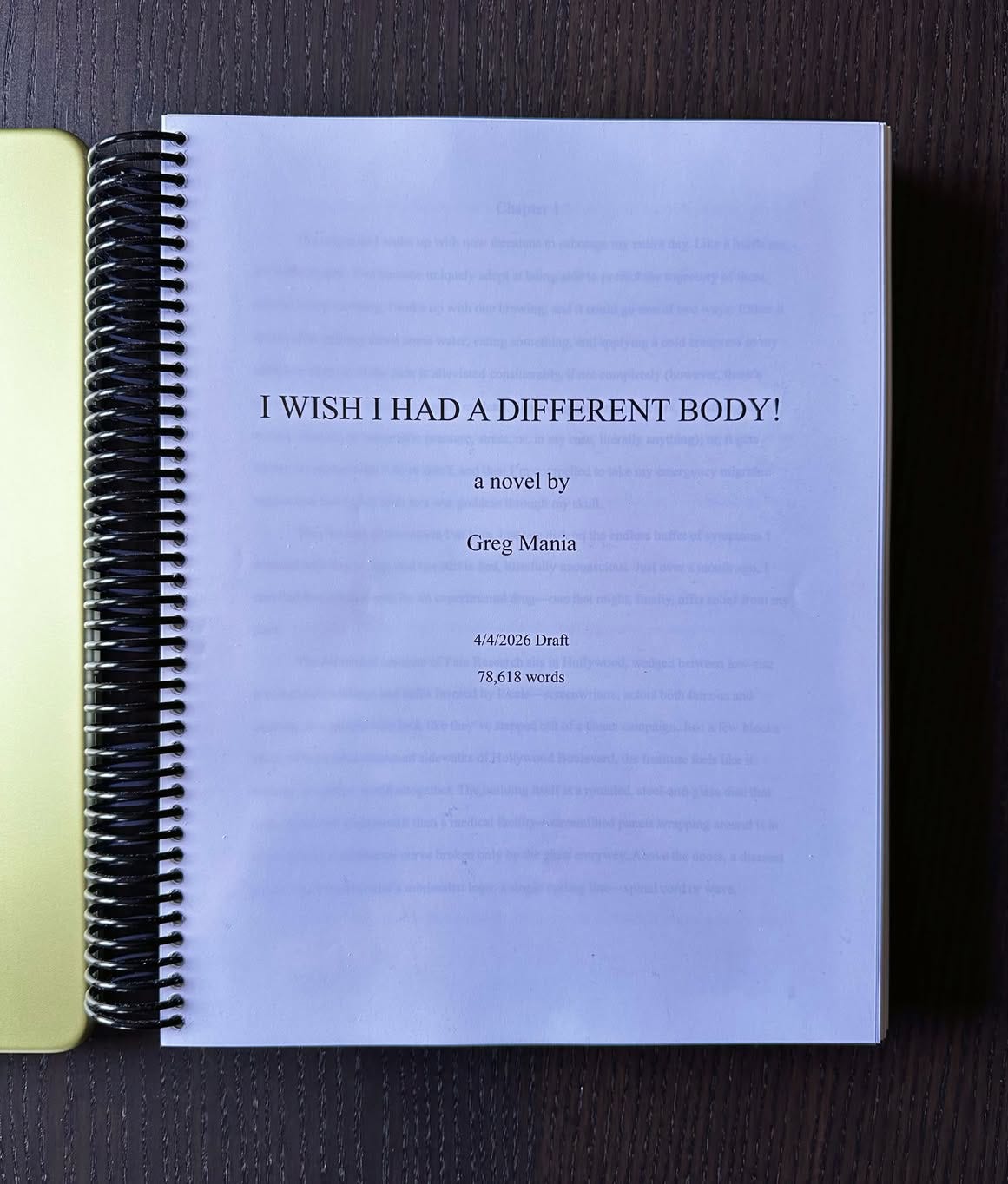
Since then, I’ve completely rewritten them, and so far, I’m not that much further along. The second draft is moving slower than a decomposing sanitary pad because not only am I addressing big structural problems, reorganizing scenes, and deepening character arcs, I’m also playing with form, texture, tone, rhythm, and cadence. I’m agonizing over sentences, fixating on jokes—reordering and swapping words, tussling with punctuation and paragraph breaks, and chewing on syllables to find the exact sonic shape I’m after, even if it means hours rewriting a single line.
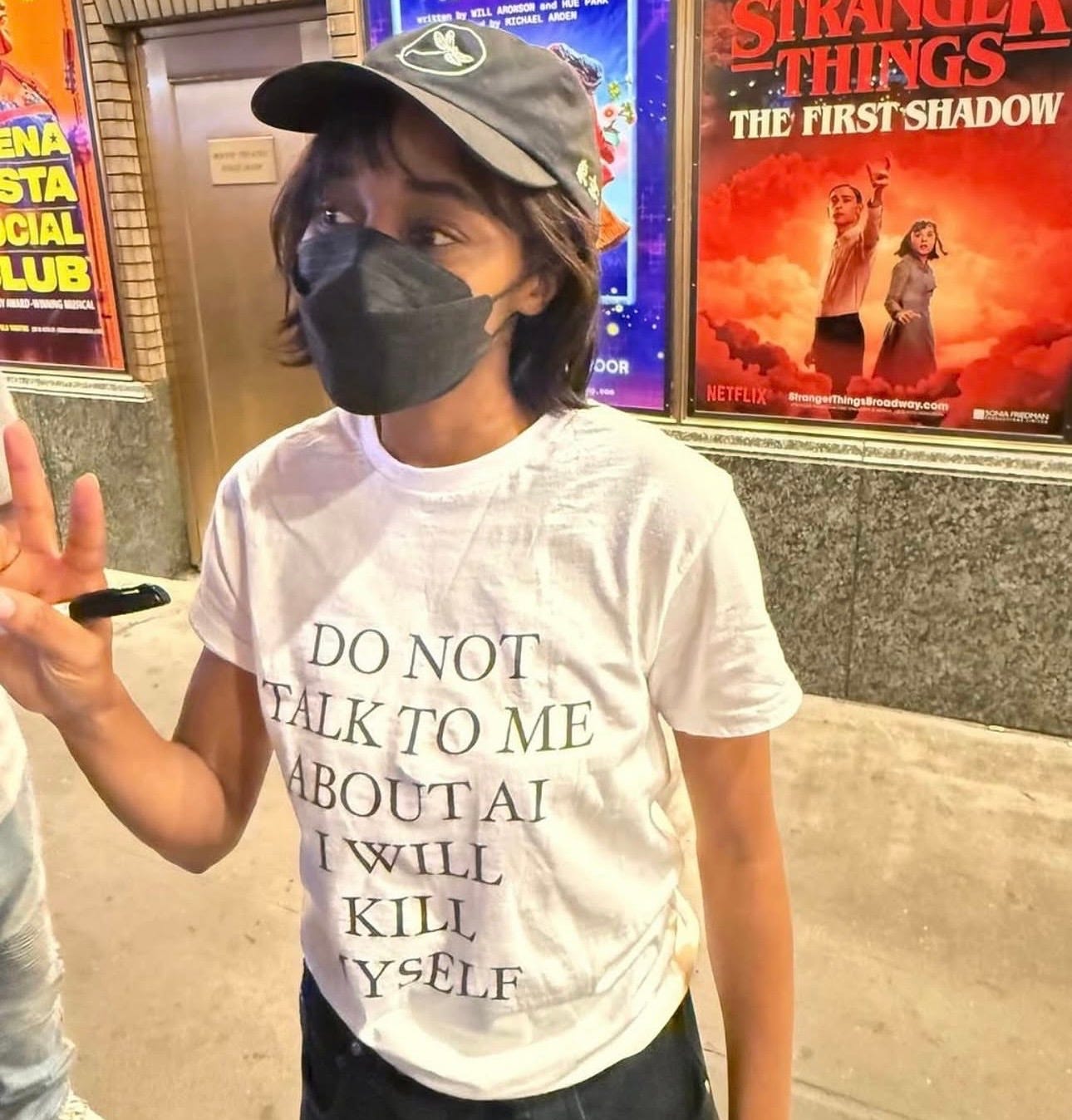
I realize all this sentence-level work is usually done in subsequent drafts, but I can’t help it—it’s part of *my* process. What’s NOT part of my process is wondering if something I wrote “sounds like AI,” which, for the first time, is a thought that came to me unbidden while working on Monday.
Honey, baby, darling.
It was like having an intrusive thought that I was immediately ashamed of having: What if I veered left and drove my car straight through that community kitchen?
I’ve been getting published for over ten years now, both online and in print—well before Ms. ChatGPTina came around. I published my first book in 2020. I’ve never been worried about being accused of using artificial intelligence to write; AI wishes it could write jokes as moronic as mine. I’ve spent years sharpening my voice, letting it evolve as I expand my thinking. The things I consume, the conversations I have, and how I navigate the world as both an individual and part of a collective all shape my work. Ultimately, it’s my way of uplifting my community and contributing to culture.
Unfortunately, it has become all but impossible to engage with the world, with culture, and with each other without brushing against the invasive tendrils of AI coiling around almost every facet of society. While the ubiquity of disruptive technologies typically neutralizes polarization, AI remains deeply divisive—yet we are far beyond dividing its adoption into problems and solutions; it has only ever been a problem, and any purported solution is instantly countervailed by the environmental destruction inherent to every model. You think it’s bad now? WAIT UNTIL YOU HAVE TO START DEFENDING DASANI AGAINST DATA CENTERS.
It impacts nearly every industry, including mine. While many fear layoffs, the threat to writers and the broader creative community goes deeper than income loss. AI simultaneously exploits our existing work and floods the market with low-quality content, burying real human voices under a tsunami of slop.
AI models are trained on millions of copyrighted books and articles without asking permission or compensating the original creators, resulting in a landmark $1.5 billion class-action settlement involving Anthropic. While the case is a win for writers by securing a payout of roughly $3,000 per registered book, imposing consequences for the illegal acquisition of pirated texts, and proving that creators can unite against major tech companies, it’s also a victory for AI firms. The court ruled that AI companies can continue to train their algorithms if they acquire the physical or digital copies through legitimate commercial channels.
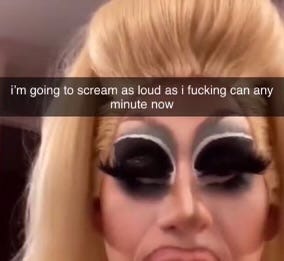
Consequently, writers face a dual crisis. Many are left feeling overwrought and helpless by rampant book piracy, yet they also fear false AI accusations. It was only a matter of time until we were hit with a literary scandal. In March, Alexandra Alter at the New York Times broke the news that Hachette cancelled the horror novel Shy Girl by Mia Ballard following allegations that large parts of the book were AI-generated. Shortly after, the Wrap reported that the New York Times cut ties with a freelance book reviewer after a reader noticed his review used AI and lifted language from an earlier review in the Guardian. Then there was the story about acclaimed literary magazine Granta publishing a prize-winning short story that is seemingly AI-generated. Earlier this week, an article published in the Atlantic, explores the shift from AI dross to commercially successful work that hits bestseller lists, citing the bestselling, self-published dystopian romance novel Daggermouth by H.M. Wolfe as an example—with no conclusive evidence to corroborate that the book was partly generated by AI. Instead, the researcher cited in the article fed Daggermouth into Pangram, an AI-detection tool that…uses AI…to detect AI.
Here is the latest as of last night: a more than $2 million two-book deal acquired by Minotaur (Macmillan) in a fourteen-way auction has abruptly collapsed. The author’s own agency pulled the manuscript from sale after admitting that they can no longer authenticate “how the manuscript evolved.” Once again, there is no concrete certainty that the author used AI. The agency claims their proof rests on how the manuscript changed during the review process, but that claim remains unfounded since it is completely unverifiable (as we will soon get into). The details are still emerging, but in their story on the controversy this morning, the Guardian disclosed the identity of the author as Jerry Falade. He has completely rejected the claims that he used AI, noting that as a Black writer, he feels targeted by the sudden, unproven suspicions. I, and so many others in the publishing world, have a lot of questions—like how a manuscript hailed as “dazzling” could pass through agents and spark a fierce, fourteen-way bidding war, only for editors to suddenly discover flat prose after the auction closed. And why did agents proactively withdraw it instead of the publishing house rescinding the offer?????? Since the story is still developing, we’ll just have to wait and see.
(It would also behoove us to clock the double standard in scrutiny here. Out of the recent high-profile controversies mentioned above, three of the authors accused of using AI—Ballard, Wolfe, and, now, Falade—are Black. Meanwhile, there are male and/or white authors who openly admit to and extol the use of AI in their work and who receive a fraction of the punitive public backlash. I’m looking at you, James Frey, Andrew Mayne [also a former OpenAI prompt engineer], and Anthony Horowitz—just to name a few.)
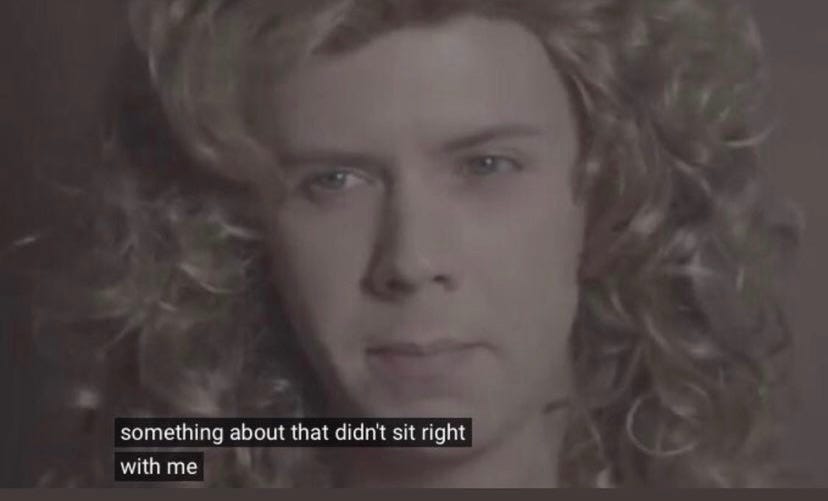
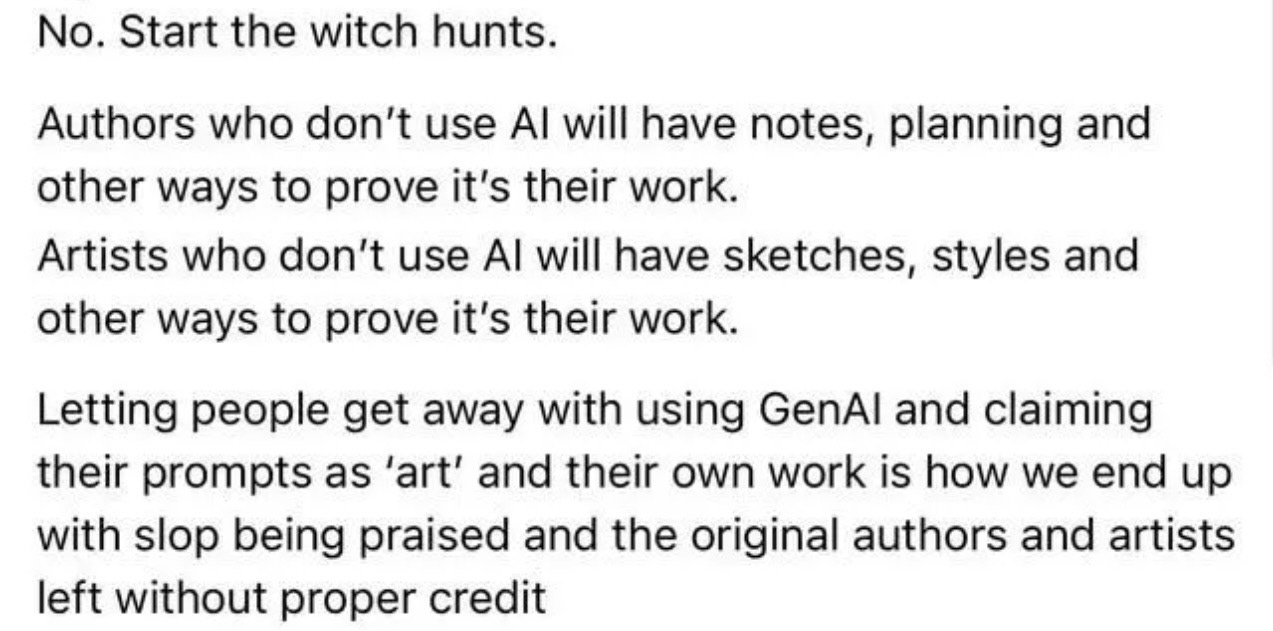
Despite the impossibility of unequivocally claiming that any given writing was generated by AI,* there are still those pushing for a witch hunt.
From a user on Threads whose name I’ve removed for privacy reasons:
*Though several tools exist to detect AI—like Pangram—they all end up relying on AI, just like Pangram. While these developers admit that their software is not 100% accurate, any returned result on a text fed through a detector—whether deemed completely, partially, or not generated by AI at all—is negated by a fundamental paradox: AI is trained entirely on human-written text. These models are optimized to replicate human linguistic patterns; ergo, any metric used by a detector to flag text as “machine-generated” is inherently a human pattern, ultimately rendering the baseline validity of the detection itself unsubstantiated.
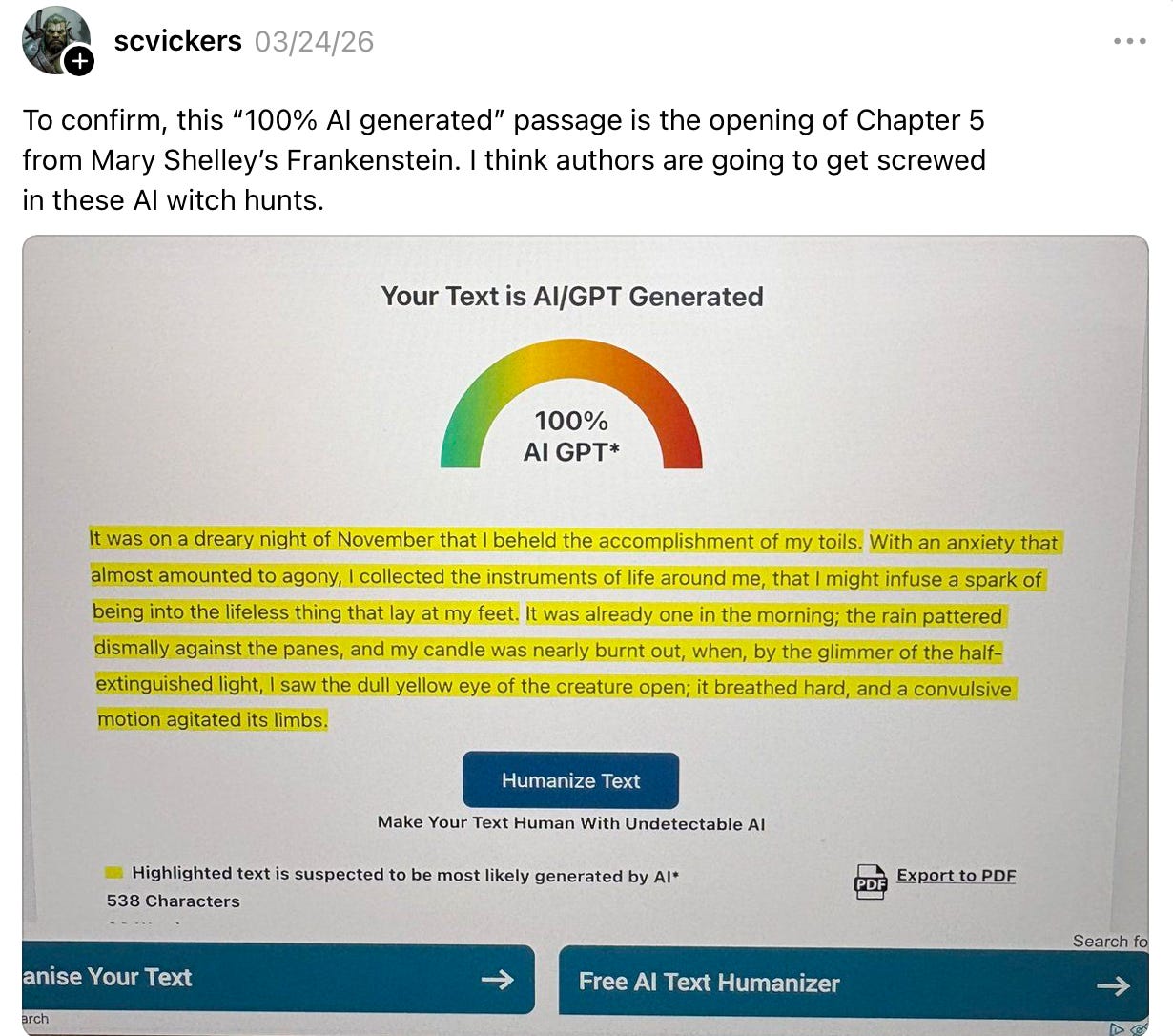
I bet if you ran this article through a detector—which you should absolutely not do, nor should you upload anyone’s work, as according to their terms of service, many platforms store submitted text to train their models and essentially facilitate intellectual property theft—it would likely test positive for AI-generated content.
Like many creators here, I’m less than thrilled that Substack has partnered with Pangram for all the reasons previously mentioned, even though Substack maintains that neither platform uses publisher content to train generative AI models. At least for now, creators can manage AI detection on their content by following these steps.
Wildly unreliable detection aside, as someone who reads and writes for a living, I’ve found most AI writing has a distinct vibe that’s easy to spot. And I’m not referring to the “tells” that public consensus formed informally, the most notable of which include phrasing like “it’s not X, it’s Y,” overuse of the rule of three, and, my personal favorite, using an em dash. I’ve made my position on these “tells” abundantly clear—most famously by personifying the em dash to respond to the allegations in McSweeney’s most-read piece of 2025. (Which, no doubt, would be 100% detected solely for copious use of the em dash—but also the rule of three, even though it’s so rare in comedy writing!!!!!!!!!)
The tell, for me, is more visceral. Most AI writing—from the 90,000 author spam emails I get a day to corporate communications, curated social media posts, and beyond—is inherently flat, convictionless, and emotionally vacant because it simulates thought rather than experiencing it. When I read something written by a human, I immediately get a sense of the author’s voice. Even if I’m unfamiliar with them, or can’t directly interpret their background, I still get an indelible mark of their humanity. With AI, I can’t get a sense of anything. It’s soulless.
BUT there is a major difference between knowing in your core that something was generated by AI and publicly accusing someone of using it. An accusation could result in severe repercussions—like a sullied reputation, lost sales, canceled contracts, and permanent career damage—among a slew of other personal and professional consequences. The problem is, many folks still rely on detection software—despite its notoriously high false-positive rates—so accusations are now being hurled frequently. It’s happening even though a detector’s verdict can’t actually be considered proof, for all the reasons outlined earlier.
Some folks are even demanding that writers show receipts—like notes, early outlines, and drafts—to prove the work is theirs. Let me address this really quick: BITCH, NO. How I write—from my scribbles to my Notes app and drafts—is the closest thing to sacred I have. That is where I go to church, and I worship alone. I’m not going to provide evidence. Not only is it an invasion of privacy, but it’s completely useless anyway since that shit can be easily faked. GTFO.
What upsets me the most about all of this is how many writers, especially aspiring and new writers, admit that their fear of being accused of using AI is forcing them to change how they write. I see so many social media posts about dropping punctuation like em dashes, inserting intentional typos, and adopting a hyper-casual tone just to avoid AI witch hunts.
I’ll admit, when I first started seeing these posts, I rolled my eyes. I couldn’t help but think: Just don’t use AI and you’ll be fine! It’s so simple! I don’t let fear of AI accusations change how I write, and neither should you! I couldn’t understand why a writer would risk stripping their work of personality and creativity just because Brenda from Temecula might publicly call them out—simply because the writing style didn’t match her personal taste, or she failed to understand the deeper meaning of the work. Or maybe Brenda just sucks!!!!!!
But I’ve come to realize: It’s actually not so simple.
Breaking out as a writer is already extremely challenging. Succeeding as a writer in the age of generative AI is exponentially more difficult. Up-and-coming writers face unprecedented challenges that previous generations never had to contend with—myself included. While it actually is easy to avoid using AI (hint: you just don’t), it’s not as easy to disregard the valid fears and anxieties taking a toll on writers right now, many of which I’ve already covered.
When I was looking for an agent and a home for my debut book, the rejections were a broken record: Memoir/essay is a crowded category. I knew every category was crowded, but I was confident that my book could stand out if ushered out into the world with the right team. Now, the market is oversaturated with synthetic text. Publishers are even more selective, driven by AI bloat and industry-wide stresses—like the rising cost of producing books, tighter consumer budgets, and the disappearance of traditional media visibility.
Breaking out as an author today requires jumping through endless new hoops. When I was building my career, the effort was already exhausting: studying the craft, reading constantly, networking, pitching, building a portfolio, maintaining a website, creating the time and finding the energy to write, grinding through revisions, and so on—all while working a day job, sometimes more than one, to pay the rent. That hustle helped me make a name for myself and publish a book. Now, a single baseless AI accusation can instantly thwart your chances with a literary journal, a magazine, or a publisher.
It’s easy for me to sit here and say “just don’t use AI and write,” because I feel like I don’t have to prove myself anymore. But if I were starting out right now? I can’t say for certain that I wouldn’t alter my own writing style just to dodge accusations, bypass the gatekeepers, and survive the initial threshold. And for marginalized writers, that crushing weight is doubled, tripled, or quadrupled depending on how many intersectional barriers you have to navigate.
The only counter to all of this is the same as it was before, and always will be: good writing.
There is something I always tell my students: Take care of your work, and your work will take care of you. When I say care, that also includes nurturing. You have to care about your words and what you are writing about, feed them by feeding yourself with the things that nourish you creatively, and let them grow unfettered by stakes, cages, or trellises. To do this, you have to get your hands dirty—be messy, bitch!!!!!
Don’t know what the fuck you’re doing? GOOD. Start there. Don’t go in with an answer. If you already have the answers, then why write it? I believe the soul of a piece of writing lives in the admission, “I don’t know,” and in what comes after the however: “I don’t know, however…” What follows that however is the heart of what you’re writing. (Yes, I am absolutely shameless enough to reference my own work. This is from a craft essay I published last year, which you can read here.)
And you know what doesn’t have a heart or soul? COMPUTERS.
Computers, including generative AI, don’t have irregularities by design—at least, not the ones that separate humans from machines. Irregularities in AI look like invented facts, fake citations, or prose that makes absolutely no sense, like describing hands resting where they can’t physically reach. Human irregularities are entirely different: they are deeply personal, jagged, weird, playful, strangely rhythmic. By stripping those away from your writing, you inadvertently end up sounding just like the generic AI you are trying to avoid.
The only true resistance here is just writing how you always write. By doing so, you develop trust with your reader. Honor what they want: your vulnerability, your distinct perspective, the story only you can tell, and the exact way you tell it. In turn, your work will take care of you by taking you exactly where you are meant to go—which is the next thing, and the next, and the next, some expected, some not. It will put you in rooms you always dreamed of being in, and on stages you feel honored to grace. It will introduce you to people, some of whom will remain in your life until the end, and some who just pass through for a short but deeply impactful season. It will welcome you into community, classrooms, and conferences. And it will always take you home.
And if someone does falsely accuse you of using AI, those people, groups, and communities will have your back and shut it down and remind you that no unlicensed audacity formed against you shall prosper.
AI is only one thing, a cheap imitation. Writing is many. It is practice, discipline, rewriting, and so much more. Writing is also an invitation.
Accept it.
If you like this, consider becoming a paid subscriber today and supporting the work it takes to make this publication possible. Thanks for your support!
You can follow my other unhinged missives by following me on Instagram, Threads, or Bluesky. Peruse my website for more work and to get in touch!
BITCH, NO. Lol, I'm with you. You want the pre-texts? Those shambles are mine and mine alone, unless you're unlucky enough to be in a class or writing group with me.
I read the book in question. A piece that is substantially or entirely AI is easy to spot as you say here. No one needs to change how they write. Amen.